


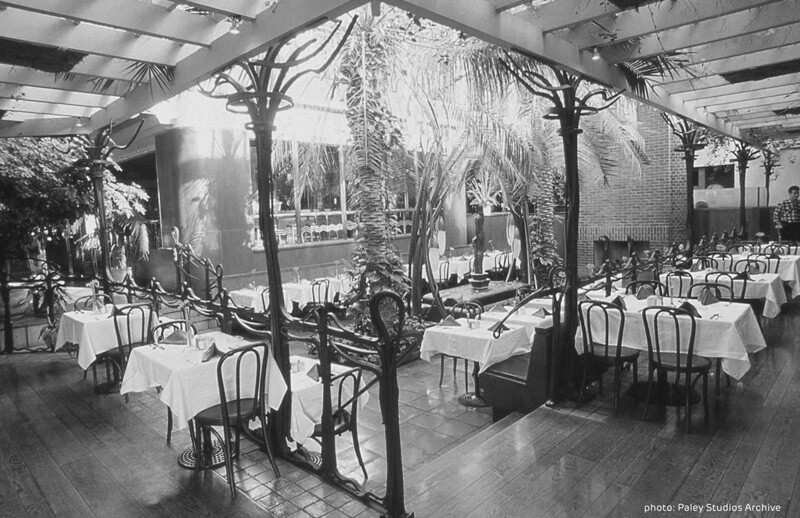
The present lot was part of an impressive multi-year commission that, in addition to architectural columns and railings, also included door handles, table legs, a fireplace andiron, and a fountain for the interior of stylish Clyde's Restaurant in Tyson's Corner, VA outside of Washington, D.C. The restaurant was designed by the late John Richard Andrews, who became known in the city as “Clyde's Architect.” Clyde's CEO John Laytham contracted Paley to design the interior. Beginning in 1979 with the columns and railings and ending in 1981 with push plates for the revolving doors, it was Paley's first use of repetitive elements in a design. Each component incorporates organic and sinuous lines, hallmarks of his elegant yet powerful creations. The restaurant opened in 1981, closed in 2017, and was well-known for its upscale roadhouse feel and eclectic décor.
“Mannerism” is a term that doesn’t get around much anymore. It used to be a key concept in art history, like Baroque and Rococo, referring both to a specific movement and to a stylistic tendency. The original Mannerists lived in the sixteenth century: the painter Parmigianino, the architect Giulio Romano, the goldsmith Benvenuto Cellini. They were fated to grow up in the shadow of the high renaissance. Some were even able to watch the ageing Michelangelo, as he completed his Sistine Chapel frescos. They reacted to all this intimidating greatness with surprising confidence—indeed, overstatement. Master technicians, they twisted matter into impossibly refined and improbably elaborate forms. Their style was exaggerated; the emotional pitch of their work, high.
The greatest exponent of the Mannerist impulse is Albert Paley. This is partly a matter of style—his way of drawing in space, at once attenuated and muscular.
Like other style descriptors (Impressionist, Fauvist and Cubist included), Mannerist was not originally intended as a compliment. The term implies a certain overwroughtness, a negative connotation which has perhaps led to its falling out of fashion. Yet it remains a useful concept, and not only for understanding the sixteenth century. Art Nouveau, for example, is clearly a Mannerist style: the pots of George Ohr, the furniture of Hector Guimard, the glass of Emile Gallé. So too is Bebop, with its articulate variations on—and deformations of—previous jazz standards.
Albert Paley b. 1944
Albert Paley is an American jewelry designer and sculptor whose work defies strict categorization as either art or craft, instead embracing the finer aspects of both disciplines.
Paley was born in Philadelphia in 1944 to lower middle class parents. Despite showing a natural inclination towards the arts, Paley held misgivings about pursuing a career as an artist. He believed the only way to earn a steady income in the arts was to find work in advertising—a proposition he found distasteful.
It was Paley’s girlfriend, a student at the Tyler School of Art, who convinced him otherwise. A single Saturday spent touring the campus and Paley was sold; he enrolled at the Tyler School of Arts with hardly enough money for a single semester’s tuition. Paley began taking classes in jewelry making and sculpture during his sophomore year and soon found himself enthralled with both crafts. Paley graduated from the Tyler School of Arts in 1969 with a Master in Fine Arts.
Paley began his professional career as a jeweler creating works of wearable art that merged the sinuous and organic lines of European Art Nouveau with the visual weight of metalwork. Later in 1969, Paley accepted a position teaching goldsmithing at the Rochester Institute of Technology, but continued to pursue his sculptural aspirations on the side. In 1972, Paley was commissioned to produce the Portal Gates at the Smithsonian Institute’s Renwick Gallery in Washington, D.C. Completed in 1973, and installed in 1976, the monumental steel, bronze and copper doors earned Paley national recognition as a metalsmith of truly unique vision.
Albert Paley’s sculptures don’t simply occupy space; they command it. Paley possesses a rare ability to transform iron from a lifeless and unyielding metal into a moving, almost liquid, element. Despite the seemingly spontaneous and organic nature of his work, Paley is a consummate draftsman, envisioning the majority of his creations on paper before stepping to the forge.
Crossing the boundaries between art and craft, Paley has established himself as one of the greatest metal artists in the country. Throughout his career, he has completed several important private and public site-specific commissions including the Clay Center Sculpture at the Clay Center for the Arts and Sciences in West Virginia and the Animals Always installation at the St. Louis Zoo. Further, his works have been widely published and can be found in multiple major museum collections around the world.


