


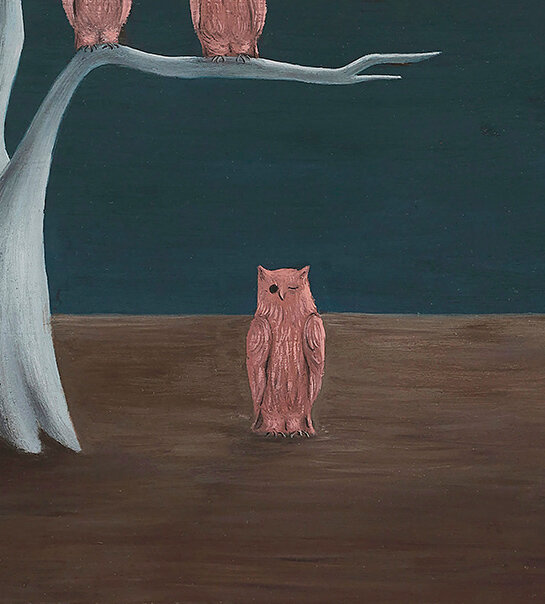
Owl Trainer No. 2, a beautifully executed authentic work by Abercrombie, was first exhibited at the Marshall Field’s Department Store Gallery in 1947, the year it was painted. She recorded two figures related to the price of the work—$100 and $75—perhaps referring to the asking price and the amount she would receive upon the sale of the work. She did not note that the painting sold, however, which probably means that it didn’t. The next reference to the work is in an undated catalog from Robert Henry Fine Arts (the Chicago Public Library lists its date as possibly 1995), from which it was sold; the current owner purchased it from that buyer.
The painting has many elements characteristic of Abercrombie: a lone woman in an austere landscape with a single leafless tree, a dark cloud, owls, and a crescent moon. Two pink owls sit on a branch of the tree that is almost parallel to the ground, while one sits beneath them. These elements held personal meaning for the artist, but despite appearing again and again in her work, each composition was unique, contributing to the differing significance of each painting. Although cats appear in some of Abercrombie’s earliest work, the earliest reference to an owl appearing in a painting is 1943 (Cat and Owl, location unknown). From that point the owl becomes ubiquitous in her work. Like the cats, owls act as surrogates or alter egos, accompanying her in her paintings, in her guises as witch or queen, or as a more conventional figure, such as in this painting.
Like the cats, owls act as surrogates or alter egos, accompanying her in her paintings, in her guises as witch or queen, or as a more conventional figure, such as in this painting.
Her interest in owls may have been inspired by an experience she recounted often, and recorded in her Joke Book. She was at a tavern in Joy, Illinois (a small town very close to Aledo, her family’s hometown in western Illinois which she visited frequently) with a friend and had to use the bathroom. She was told that there was no bathroom, everyone just went out back, but they didn’t want her to do that, so a waitress took her down the street to an empty building with a large bathroom on the second floor. There was a shelf in the room with a stuffed owl sitting on it. She thought about this owl often (and painted the scene frequently) and on a visit to Joy years later, inquired about the stuffed owl, which she wanted to purchase. After finding the owner of the building, she was told there never was a stuffed owl in the room although many flew in and out through the window. Abercrombie loved the story and told it often. Abercrombie did acquire a stuffed owl of her own at some point, presumably after the time the visit took place.
Although owls are seen regularly in her work, they are often brownish and rather fierce looking creatures, conveying their menacing nature. Abercrombie’s stuffed owl conformed to this powerful and ferocious type of owl. The pink owls, which appear as early as 1945, perhaps in response to her daughter Dinah’s request for a pink picture, are much less threatening, which does not necessarily mean that they are powerless.
Although I know of only one other painting that shares this particular theme (Owl Trainer [School for Owls], 1945, private collection), Abercrombie did a number of paintings in which owls were situated in or on leafless tress. In the earlier Owl Trainer, a much smaller Abercrombie presides over a larger tree, equipped with a similarly unemployed whip. Three tiny pink owls are in the tree, one peering out from an opening in the trunk, while a fourth sits on the ground. As in Owl Trainer No. 2, Abercrombie seems to direct her attention to the bird on the ground. In Four Trees and Three Owls (Four Trees) (1950, Private Collection), the three owls are tiny but conform to the more standard brownish color associated with the birds, while the trees have an anthropomorphic quality similar to that in Owl Trainer No. 2.
The painting that seems closest in spirit to Owl Trainer No. 2 is The Truant (4 Owls) (1956, Private Collection) despite the absence of a human figure in that work. In this painting the owls are whitish, three sitting on the leafless branch of a tree, one sitting at the base of the tree in the shadow cast by its trunk, refusing to join the others, including the larger, dominant bird on the branch (perhaps a stand in for the absent artist). The “truant” owl parallels the owl standing below the tree in Owl Trainer No. 2, who winks coyly at the viewer as if to assert its independence from the authority of the trainer and her elegant but ineffectual whip.
Like Abercrombie’s best paintings, this one is skillfully composed, the winking owl placed center stage between the verticals of the sinuous white tree on the left and the flattened, simplified silhouette of the black clad Abercrombie on the right. A black cloud hovers above the owls in the tree while a small crescent moon is seen in the upper right. The figure gestures to the owl on the ground with a pointed forefinger, echoed by the end of the tree branch on which the owls are seated. Even the shape of cloud seems to repeat this gesture (in this case, upside down), turning it back on Abercrombie, suggesting that she is not wholly in control of these birds and augmenting its significance in the painting.
Abercrombie herself wished to possess both the ostensible dominance of the Trainer and the rebelliousness of the winking owl, as she wished to possess both the wisdom and the menace of the owls who appear in so many of her works.
What do these deceptively cute, simple, sweet pink owls tell us? Despite their seeming harmlessness, the trainer is not really in charge. She stands, whip to her side, pointing at the winking bird who is refusing her orders. Abercrombie herself wished to possess both the ostensible dominance of the Trainer and the rebelliousness of the winking owl, as she wished to possess both the wisdom and the menace of the owls who appear in so many of her works. Posing as witch or queen, her own insecurities were obscured, and she became wise and powerful. The very ambiguity of the role she is playing in this painting conveys the precarious nature of these qualities. Along with the wit and humor so characteristic of her best works, Abercrombie poignantly reveals the unstable balance between her own desire for power and dominance and the insecurities that plagued her all of her life.


He never blinked an eye all the time I was in the ladies room. It's true.
Excerpt from Gertrude Abercrombie’s Joke Book
Gertrude Abercrombie 1909–1977
Gertrude Abercrombie was at the center of the Chicago arts scene in the 1940s and 1950s, both as a painter of captivating, surrealist scenes and as the self-proclaimed “Queen of Bohemia,” hosting parties and gatherings for the creative denizens of Chicago.
Abercrombie was born in 1909 in Austin, TX, where her parents were passing through as part of a traveling opera company. The family lived in Berlin for a short time, before moving back to the states when World War I broke out, eventually settling in Hyde Park, Chicago in 1916, where Abercrombie would live for the rest of her life. In 1929, she graduated from the University of Illinois with a degree in romance languages and, soon after, studied figure drawing at The Art Institute of Chicago, followed by a yearlong course in commercial art at the American Academy of Art in Chicago. Before completely devoting herself to her painting in 1932, Abercrombie worked drawing gloves for Mesirow Department Store and as an artist for Sears.


