


The true artist helps the world by revealing mystic truths.
Bruce Nauman
Artists who publish books of documentation are, in a sense, using the artform to its simplest degree. —Tim Guest, 1981
Sharing an artwork through the very public method of printing and reproduction is the epitome of democratic dissemination. In their seminal 1981 publication Books By Artists, Tim Guest and Germano Celant begin by addressing their audience’s predictable desire to define a book. They suggest that it is not really possible – or necessary – to define what an artist book is, because any given work becomes a conceptual extension of the artist and is therefore an object of infinite incarnations.
There is too frequently a misinterpretation of printed works and editions as lesser commodities in the market. With artist’s books, the goal was often to distance an artist’s idea from the proverbial canvas, to use words and non-dimensional media as a means to engender and distribute a creative philosophy. Such efforts often led to the creation of superbly idiosyncratic editioned works that succinctly communicate an artist’s entire conceptual foundation, however ineffable. In this way, the artist’s book and the development of conceptual art are inextricably linked. Take, for example, Seth Siegelaub’s July, August, September 1969 exhibition catalogue in which the book is the exhibition. On its pages, it brings together eleven works from eleven artists working in separate locations, works that never physically shared premises themselves.
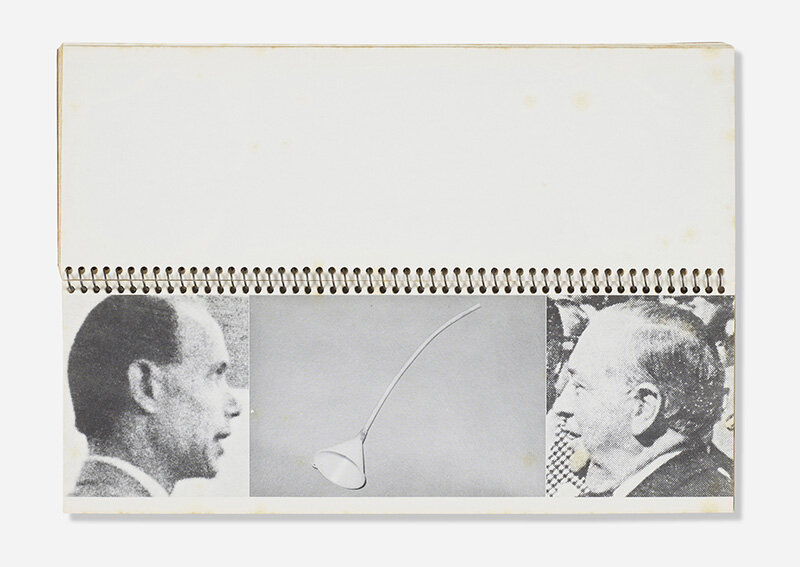
For artists like John Baldessari and Ed Ruscha, whose broad outputs often hinged on the collision of word and image, the book became a quintessential medium. One of my favorites from this selection is Baldessari’s rare Brutus Killed Caesar, in which two unknown antagonists face each other with a randomized household object between them. It is understood that these objects are murder weapons, but nothing violent takes place outside of the viewer’s imagination, likely shaped by earlier historical texts like Shakespeare’s The Tragedy of Julius Caesar. Brilliant. Another scarce title herewith is Ruscha’s Dutch Details. Comprised of multiple images taken by the artist showing bridges in The Netherlands, it plays off of his Every Building on the Sunset Strip from five years earlier. Oblong as well, with large fold-outs, this book was very difficult to produce and the publisher did not fulfill the edition, therefore making this the rarest of Ruscha’s coveted artist books.
The book’s potential for comprehensively documenting an ephemeral work or performance was critical for many artists, including Gordon Matta-Clark and Bruce Nauman, the latter whom made an artist’s book (Burning Small Fires) about burning another artist’s book (Ruscha’s Various Small Fires and Milk).
The pursuit to collect such a wide and comprehensive library of these titles is a passionate endeavor, and it is my view that no collection could be complete without the artist’s book. A personal library needs this texture to augment the rigid monographs and academic surveys that equate the bulk of most collections. Whether a single rarity catches your eye or you’re drawn to group lots from the likes of Christian Boltanski, Gilbert & George, Richard Prince, and Sol LeWitt, Cover to Cover is a fantastic opportunity to bolster an existing reading room or to plant the seed of a collection to cherish for years to come.
—Peter Jefferson, Senior Specialist
Bruce Nauman b. 1941
Bruce Nauman is one of the most influential and experimental American artists of the post-war era, known for his groundbreaking work across performance, video, sculpture, and installation. Born in 1941 in Fort Wayne, Indiana, he studied mathematics and physics at the University of Wisconsin - Madison before earning his MFA in art from the University of California, Davis in 1966. Early in his career, he supported himself through teaching positions at the San Francisco Art Institute and UC Irvine, all while developing a radical, questioning approach to artmaking.
Nauman’s work is rooted in conceptualism and marked by a constant investigation into the definition and boundaries of art. Refusing to adhere to traditional categories, he has employed diverse media including neon, sound, surveillance video, and bodily performance to explore perception, language, power, and the passage of time. His installations often confront viewers physically or psychologically, creating disorienting, repetitive, or absurd experiences that challenge habits of interpretation.
Nauman’s contributions to contemporary art have been widely recognized with his work residing in leading collections around the world. In addition, in 2009, he represented the United States at the 53rd Venice Biennale, where the U.S. Pavilion received the Golden Lion for Best National Participation. He has been the subject of major retrospectives at institutions such as the Museum of Modern Art and MoMA PS1 in New York, the Tate Modern in London, and the Stedelijk Museum in Amsterdam.


